Taught in Garages, Learned in Basements: America's Secret Economy of Useful Knowledge
Somewhere in your neighborhood, someone is teaching someone else how to do something nobody's paying them to teach. No Yelp listing, no course fee, no certificate at the end — just knowledge moving from one pair of hands to another. This is the underground economy of skill-sharing, and it's quietly thriving all across America.
It doesn't show up in GDP reports. It doesn't have a subreddit with a million followers. But talk to the right people — the guy three streets over who's rebuilt six transmissions this year, or the woman who's taught fourteen neighbors how to can tomatoes in her kitchen — and you'll find a whole parallel education system running just beneath the surface of ordinary American life.
The Classroom Nobody Built
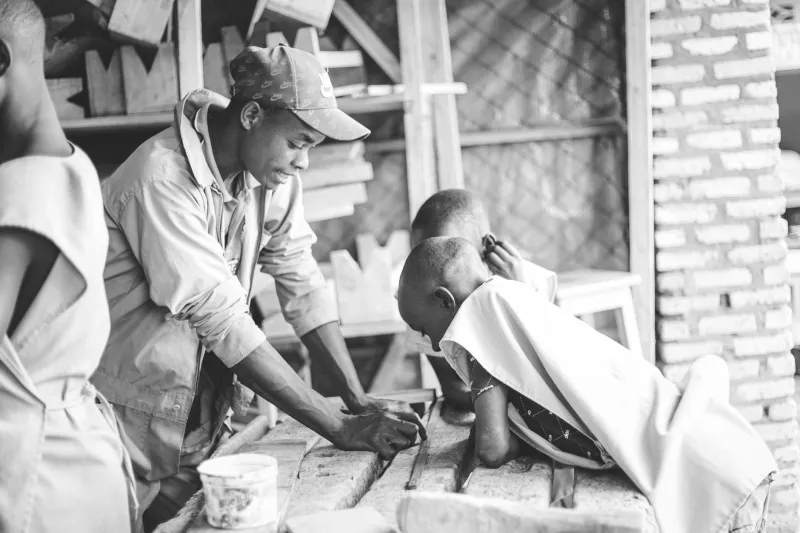
Let's be clear about what we're talking about. This isn't YouTube tutorials or community college night classes. This is personal, local, and deliberately low-profile. A retired electrician in Tucson who spends Saturday mornings walking his neighbor's kid through basic wiring. A woodworker in rural Ohio who takes on one apprentice a year, no money exchanged, just time and sawdust and the slow accumulation of craft. A woman in South Chicago who holds monthly sessions in her living room teaching sewing, alterations, and pattern-making to anyone who shows up.
None of these people advertise. Most of them would shrug if you called them teachers. But they're filling a gap so wide you could drive a truck through it — the gap between what formal institutions bother to teach and what people actually need to know.
"There's stuff I learned from my grandfather that I can't find in any YouTube video," says Marcus, a 44-year-old mechanic in Albuquerque who regularly mentors younger guys from his block. "And if I don't pass it on, it just disappears. That felt wrong to me."
Why It Stays Underground
So why the secrecy? Why aren't these people hanging out a shingle?
Some of it is liability — the moment you start formally teaching, you open yourself up to all kinds of legal exposure, especially in trades. A plumber teaching someone to fix their own pipes could, in theory, run afoul of licensing regulations. A home baker teaching pastry technique in her kitchen isn't exactly operating a licensed food facility. The informal nature isn't just a vibe — it's a shield.
But there's something else going on too, something harder to quantify. A lot of these exchanges happen within webs of trust that don't scale. They're rooted in community, in reciprocity, in the kind of relationship where you know someone well enough to hand them a power tool and trust they won't take your finger off with it. Formalizing that changes it. It turns a favor into a transaction, a relationship into a service.
"The moment you put a price on it, people treat it differently," says Denise, who's been teaching quilting out of her garage in rural Tennessee for over a decade. "I don't want students. I want neighbors who can quilt."
What's Being Taught — and Why It Matters
The range of skills circulating in this underground is genuinely surprising. Yes, there's the expected stuff — basic car maintenance, home repair, cooking. But dig deeper and you find beekeeping networks passing down hive management techniques that predate modern commercial practices. Small-scale farmers quietly teaching soil science they learned from their grandparents, methods that no agricultural extension office has ever documented. Urban foragers mentoring newcomers on which plants are safe and which will ruin your afternoon.
There are also skills that feel almost deliberately countercultural — people teaching their neighbors how to repair electronics instead of replacing them, how to resole shoes, how to sharpen tools properly. In a throwaway economy, these feel almost radical.
What's interesting is how often the motivation behind these exchanges is explicitly about preservation. People teaching these skills aren't just being generous — they're worried. Worried that if they don't pass this on, it vanishes. That the knowledge dies with them. That the next generation will have to pay someone $200 an hour for something that used to be common sense.
"My dad could fix anything," says Ray, a 58-year-old HVAC technician in Detroit who now hosts informal repair workshops in his garage. "I mean anything. That generation just knew how things worked. We've lost that. I'm trying to put a little of it back."
The Community It Creates
Here's the thing nobody talks about when they discuss skill-sharing: it builds something that's genuinely hard to manufacture. Community. Real, functional, we-actually-know-each-other community.
When Marcus teaches a neighbor's kid how an engine works, that's not just a transfer of mechanical knowledge. It's a relationship. It's trust established over an afternoon. It's the beginning of a social fabric that doesn't come with an app or a subscription fee.
Researchers who study social capital — the invisible glue that holds communities together — have long noted that shared doing builds connection more effectively than shared consuming. Watching a movie together is nice. Learning to weld together is something else entirely.
This might explain why these informal networks tend to be remarkably durable. They persist through economic downturns, through neighborhood demographic shifts, through the general social fragmentation that's become a defining feature of American life. Because they're built on something more solid than convenience.
The Gap in the Map
There's an uncomfortable implication lurking in all of this: formal education has failed to teach people things they desperately want to know. Not abstract failures of curriculum design — concrete, practical, daily-life failures. People don't know how to fix a leaky faucet. They can't change their own brakes. They've never made anything from raw materials. And they feel that absence.
The underground skill economy isn't just a charming quirk of American self-reliance. It's a workaround. It's people solving a problem that institutions either can't or won't solve.
That's worth sitting with. Because the knowledge being exchanged in garages and basements and living rooms across this country didn't appear out of nowhere. Someone learned it. Someone preserved it. Someone decided it was worth passing on even when nobody was watching.
Maybe especially when nobody was watching.
The Quiet Revolution Nobody's Photographing
You won't find this on Instagram. There are no aesthetic flat-lays of artisan tools, no before-and-after reels, no sponsored content from a skill-share platform. That's almost the point. This is knowledge-sharing that exists outside the attention economy entirely, which, in 2024, might make it the most genuinely countercultural thing happening in America.
The next time you see a light on in a neighbor's garage at 10pm, or catch the smell of sawdust drifting from a backyard shed, or notice a group of people crowded around something in a driveway — there's a decent chance someone's being taught something. Something old, something useful, something that someone decided was too important to let disappear.
And that, honestly, is one of the more hopeful things going on right now.