The Unofficial Record Keepers: Meet the Americans Cataloging Things That Shouldn't Exist
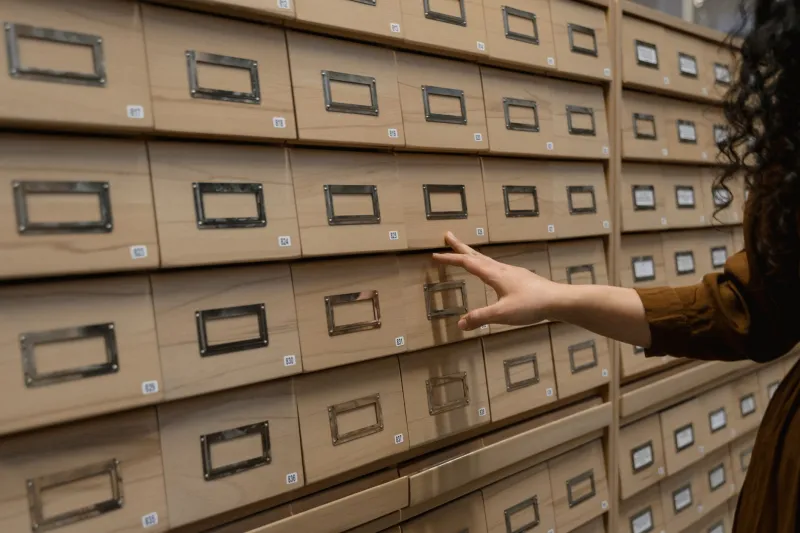
In a small town outside Knoxville, a woman named Diane Pratt has a filing system that would make a reference librarian nervous. There are color-coded binders, a custom spreadsheet with seventeen columns, and three external hard drives that she backs up religiously every Sunday after church. The subject of all this careful organization? A series of disappearances — not people, but stories. Specifically, oral accounts from elderly residents in her county about a local event from the 1940s that appears in no official record anywhere.
"People kept telling me about this thing," she says. "A fire, some kind of accident, something that happened at the old mill. Everyone over eighty seemed to know about it. But there's nothing in the newspaper archives. Nothing in county records. It's like it never happened — except it clearly did."
Diane is not a historian. She's a middle school librarian. But she's been quietly interviewing residents, cross-referencing death records, and building what might be the only existing documentation of an event that the official record has completely swallowed.
She's also, in the growing vocabulary of the internet age, a grassroots documentarian — one of thousands of Americans who have taken it upon themselves to record things that mainstream institutions either can't or won't.
The Gap Between Official and Real
Here's an uncomfortable truth about the historical record: it has always had enormous blind spots. Events that happened to the wrong people, in the wrong places, or in ways that were inconvenient to document have routinely fallen through the cracks. Local folklore, undocumented community practices, contested events, and phenomena that don't fit neatly into academic categories have always existed in a kind of limbo — real to the people who experienced them, invisible to everyone else.
What's different now is that a whole class of people has decided to do something about it.
The tools that made this possible arrived gradually. Digital cameras got cheap. GPS became universal. Social media created platforms where niche interests could find each other across geographic distances. And cloud storage meant that a single dedicated individual could maintain an archive that would have required an institution just twenty years ago.
The result is a sprawling, decentralized ecosystem of amateur documentarians working across an almost comically wide range of subjects — from the scientifically contested to the historically neglected to the genuinely, defiantly weird.
The Cryptid Crowd (And Why They're More Serious Than You Think)
Let's address the obvious entry point: yes, some of these people are looking for Bigfoot. But spend any time in these communities and you'll quickly discover that the most dedicated members are doing something more nuanced than monster hunting.
Take the Gulf Coast Anomalous Phenomena Network, a loose collective of about 200 amateur researchers spread across Louisiana, Mississippi, and Alabama. Founded by a retired electrician named Roy Thibodaux, the group does systematic documentation of unusual sightings, unexplained sounds, and local legends across the region — using GPS coordinates, timestamp photography, and structured interview protocols borrowed from social science research.
"We're not trying to prove anything," Roy says carefully. "We're trying to record what people experience and report. That's it. Whether you believe the explanation or not, the experiences are real and they belong in some kind of record."
This epistemological humility is common in the better-organized corners of the grassroots documentation world. The goal isn't to validate or debunk — it's to preserve. The question isn't "did this happen" but "what do people say happened, and why does that matter?"
Folklorists and some cultural anthropologists are paying attention. A growing number of academics have begun treating these community archives as legitimate primary sources — not because they prove the existence of anything paranormal, but because they're often the only systematic record of what communities believed, feared, and experienced.
Documenting the Disappearing
Not everything these documentarians chase is mysterious. Some of the most compelling work is simply about capturing cultural practices before they vanish entirely.
In rural Appalachia, a 26-year-old named Caleb Simmons has spent three years recording traditional foodways — specific preparation methods, regional ingredient variations, and the oral knowledge that accompanies them — that exist nowhere in written form. He uses video, audio, and detailed written notes, and he's been quietly building relationships with older community members who are often surprised that anyone considers their knowledge worth preserving.
"There's a woman in my county who knows seventeen different uses for pawpaw fruit," he says. "She learned them from her mother, who learned them from her mother. When she's gone, that's gone. Unless I write it down."
Caleb's archive — currently a combination of a private YouTube channel, a detailed blog, and several hard drives — has been cited by two food historians and referenced in a regional cookbook. He has no formal credentials. He's a warehouse supervisor who does this on weekends.
This pattern repeats across the country. A retired teacher in New Mexico documenting the last practitioners of a regional weaving tradition. A college student in upstate New York systematically photographing and cataloging the ruins of small industrial sites that no historical society has gotten around to. A former journalist in Detroit recording oral histories from longtime residents of neighborhoods that are being rapidly redeveloped.
The Legitimacy Question
The uncomfortable tension running through all of this is the question of authority. Who decides what gets documented? Who decides what's real, what's significant, what deserves preservation?
For most of human history, those questions were answered by institutions — universities, governments, newspapers, churches. And those institutions, as Diane Pratt's missing mill fire suggests, have always had gaps.
Social media hasn't solved that problem, but it has done something interesting: it's made the gaps visible, and it's created infrastructure for people to fill them independently. A Facebook group about regional folklore can accumulate a decade of community knowledge. A subreddit dedicated to local history can surface documents and photographs that no archive knew existed. A YouTube channel run by one dedicated amateur can preserve interviews that no institution thought to commission.
"The question isn't whether this is 'real' documentation," says one cultural anthropologist who has collaborated with several grassroots groups. "The question is whether we're going to be snobbish about methodology while genuinely important material disappears. And I don't think we can afford to be."
What the Filing System Knows
Diane Pratt still hasn't solved the mystery of the mill. She has seventeen interview transcripts, a hand-drawn map of where the mill used to stand, and a growing suspicion that the silence in the official record is itself a kind of answer — that something happened that someone, at some point, decided shouldn't be written down.
She's not sure she'll ever know the full story. But she's made sure that what people remember — the fragments, the half-stories, the things whispered by people who were children when it happened — won't disappear when they do.
"I'm not a historian," she says again, when asked why she does this. "But someone has to write things down. And historians are busy."
Somewhere between that pragmatic shrug and those seventeen color-coded binders, something important is happening to the American record. It's getting messier, stranger, and significantly more complete.