Clack Is Back: The Stubborn Craftsmen Keeping Mechanical Typewriters From the Grave
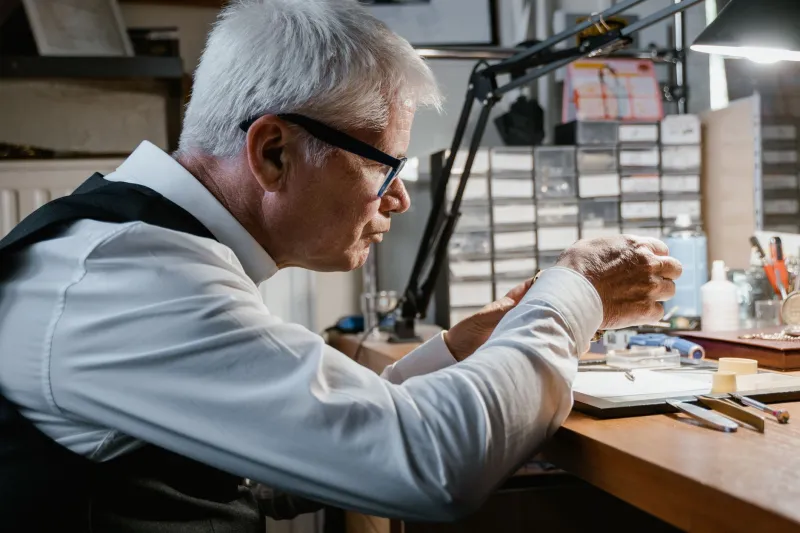
Somewhere in a shop that smells like machine oil and old rubber, a man named Ken is elbow-deep in a 1962 Olympia SM4. He's been doing this for over four decades. His waiting list stretches three months. His phone rings constantly. And the people calling him aren't antique dealers or museum curators — they're novelists, college students, podcasters, and at least one well-known screenwriter who refuses to draft on anything else.
The typewriter, by every reasonable cultural metric, should be dead. It lost the war to the personal computer sometime around 1985, got a brief sympathy wave in the early 2000s, and was supposed to spend eternity in thrift store windows between a broken bread maker and a complete set of Encyclopedia Britannica. And yet. Here we are.
The Last of a Vanishing Guild
At its peak, typewriter repair was a legitimate trade with dedicated schools, manufacturer-run certification programs, and shops in nearly every American city. IBM, Olivetti, and Royal all had extensive service networks. Repair technicians were respected professionals. Then the bottom fell out — not slowly, but fast enough that most of the knowledge walked out the door with the people who held it.
Today, the number of people in the US who can perform a full mechanical restoration on a vintage typewriter — not just clean the keys, but actually diagnose, source parts, and rebuild the escapement mechanism that controls character spacing — is estimated somewhere in the dozens. Maybe fewer. Nobody keeps an official count, because nobody thought they'd need to.
What's left is a loose, informal network of aging specialists and a handful of younger self-taught enthusiasts who learned the craft from YouTube videos, crumbling repair manuals, and a lot of trial and error. Some operate out of dedicated storefronts. Others work from their garages. Most have more work than they can handle.
Why People Are Actually Using These Things
Here's the part that surprises people: a significant chunk of the demand isn't nostalgic at all. It's practical — or at least, practical-adjacent.
Writers cite the lack of distraction as a genuine productivity tool. A typewriter can't check your email. It won't surface a notification about a sale at REI. It doesn't have a browser. For people who struggle with the infinite pull of an internet-connected device, a machine that does exactly one thing turns out to be genuinely useful. Cognitive load, reduced. Words on paper, increased.
There's also the tactile argument. The physical resistance of the keys, the sound, the sensation of letters actually striking a page — for certain people, that feedback loop creates a writing experience that feels more deliberate, more committed. You can't quietly delete a sentence on a typewriter. You have to physically cross it out or retype the whole page. Some writers find that constraint liberating rather than frustrating.
And then there are the artists. Typewriter art — using the characters to create images, patterns, and portraits — has developed its own devoted following online, with practitioners who treat specific typeface configurations as a medium as serious as any other.
The Economics of Obsolete Machinery
Repair pricing varies wildly depending on the machine, the technician, and the extent of the work. A basic cleaning and adjustment might run $75 to $150. A full restoration on a complex machine — say, an IBM Selectric with its notoriously intricate typing ball mechanism — can push past $400 or $500. And people are paying it.
The parts situation is genuinely complicated. Some components can be sourced from machines being cannibalized for parts — a grim but practical solution that's created a secondary market in "donor" typewriters. Others require fabrication, which a small number of machinists have quietly turned into a niche side business. A few crucial rubber components, like the platens that paper rolls around, are being reproduced by specialty manufacturers who spotted the demand and moved on it.
The supply chain, in other words, is improvised. Held together by ingenuity, community knowledge-sharing, and the kind of stubborn refusal to let things die that Americans tend to romanticize when they see it in other contexts.
What Happens When Ken Retires?
This is the question hanging over the whole ecosystem. The most experienced typewriter technicians in the country are mostly in their 60s and 70s. They learned their trade during an era when the machines were current technology, not curiosities. That institutional knowledge — the kind that lives in a person's hands as much as their head — doesn't transfer easily.
Some are actively trying to pass it on. Small workshops and weekend intensives have started appearing, drawing students who want to learn the craft seriously. Online forums and video channels have built surprisingly detailed technical libraries. The Antique Typewriter Collectors community and similar groups have become informal repositories of repair knowledge.
But there's a real gap between enthusiast-level tinkering and professional-grade repair. Diagnosing a subtle timing issue on a mid-century Royal Quiet De Luxe requires a kind of pattern recognition that only comes from having seen hundreds of the same failure modes across years of work. You can read about it. It's not quite the same.
The Machine That Refused to Disappear
Maybe the more interesting question isn't whether typewriter repair can survive — it's what the persistence of this whole subculture says about us.
We live in an era of frictionless everything. Streaming instead of owning. Subscription instead of buying. Cloud instead of local. The typewriter is the opposite of all of that. It's heavy. It's loud. It requires maintenance. It produces a physical object you have to deal with. There's no undo button, no autosave, no sync across devices.
And somehow, that's the point. In a world where everything is optimized for convenience, there's a growing contingent of people who want to do at least one thing the hard way. Not because it's better, necessarily — but because the difficulty is the experience. Because the clack of the keys and the ding of the carriage return and the slightly uneven impression of a letter that needs a new ribbon are all part of something that feels, stubbornly and defiantly, real.
Ken will retire someday. His waiting list will close. The people who can do what he does will get older, and some of what they know will go with them.
But there will be someone younger, covered in machine oil, squinting at a mechanism that hasn't been manufactured in forty years, figuring it out. There always is.